

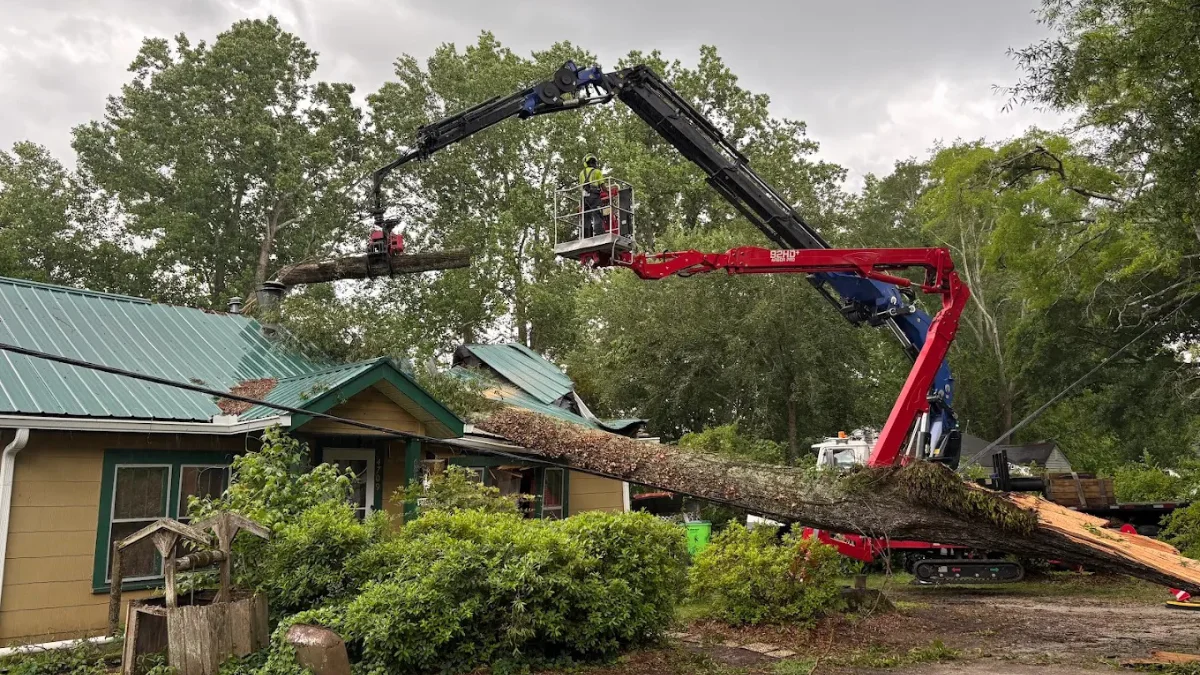
Large tree removal looks straightforward from the outside. The tree comes down, someone hauls it away, and the yard looks different. But in practice, removing a large tree near a home, power line, or any other structure is one of the most technically demanding and genuinely dangerous jobs in residential property care. Here’s what homeowners in Northwest Atlanta need to know before the work begins.
Why Large Tree Removal Is Nothing Like Cutting Down a Small Tree
Large tree removal is fundamentally different from removing a small ornamental tree or a shrub. The scale changes everything, and the margin for error shrinks dramatically as the tree gets bigger.
A mature tree that stands 60 or more feet tall, which is common for loblolly pines, white oaks, and sweetgum trees across Cobb and Paulding Counties, can weigh tens of thousands of pounds. That weight is distributed across the canopy, the trunk, and the root system in ways that aren’t obvious from the ground. According to the Tree Care Industry Association, tree work consistently ranks among the most dangerous occupations in the United States, with fatalities occurring even among experienced crews when proper planning isn’t followed.
Trees near structures almost always require what’s called sectional removal. That means cutting the tree down in sections from the top rather than felling the whole thing at once. This is slower, more technical, and requires rigging systems, specialized equipment, and experienced workers who understand load calculations and how a cut section will behave as it falls. A miscalculation in how a large section is rigged can send it crashing through a roof or fence instead of landing in the drop zone.
The Equipment Question: Why It Actually Matters
Not every tree service has the right equipment for a large tree job. This is worth asking about directly before you hire anyone.
A company that shows up with a chainsaw and a pickup truck is not equipped to remove a 70-foot water oak that’s leaning toward your house in Marietta or Douglasville. Large tree removal requires cranes or aerial lifts in some situations, proper rigging hardware, wood chippers rated for large-diameter wood, and in some cases, robotic removal systems. The equipment a company brings tells you a lot about whether they’ve actually done this kind of work before.
QDS TreeWorx’s robotic tree removal technology and safety standards represent a meaningful advancement over traditional methods. Robotic systems allow large sections of a tree to be removed with greater precision and with less physical risk to workers. They’re especially valuable in tight situations, like a tree that’s grown up against the side of a house in a Powder Springs subdivision, or a storm-damaged pine that’s partially suspended over a carport in Woodstock. Traditional climbing in those situations puts workers at serious risk. Robotic systems reduce that risk without sacrificing the precision the job demands.
What to Check Before You Hire a Tree Service
Before you sign anything or let anyone start work, there are several things you need to verify. This is not being difficult. It’s protecting yourself.
First, verify licensing. Tree removal companies operating in Georgia need to be properly licensed. Ask for documentation and check it. Second, ask for proof of both general liability insurance and workers’ compensation insurance. Get the actual certificate, not just a verbal confirmation. Verify that it’s current and that all crew members who will be on your property are covered. If a worker is hurt on your property and the company doesn’t carry workers’ comp, you could be held liable. Third, ask whether the company follows ISA (International Society of Arboriculture) and OSHA safety standards. Professional companies do. If they don’t know what those acronyms mean, that tells you something.
(And yes, it’s completely reasonable to call the insurance company directly to confirm the certificate is valid. Reputable companies won’t be offended by that.)
Experience matters too. Ask how long the company has been operating. Large tree removal is not a job for a crew that started last spring. It takes years to develop the judgment and skill needed to read a tree correctly, plan the removal, and execute it safely. You’re also looking for local experience specifically. A company that’s been working in Cobb and Douglas Counties for decades will know Georgia’s clay-heavy soils, the root behavior of local species, and how summer storms in this region affect tree structure differently than companies from elsewhere might.
Permits, HOAs, and Things You Don’t Want to Skip
Some Georgia municipalities and counties require permits before you remove a tree above a certain size. Cobb County, for example, has tree protection ordinances that apply in certain situations. Cherokee County and Paulding County have their own requirements. These rules exist to protect the tree canopy, and violating them can result in fines.
Many Northwest Atlanta communities also have HOA rules that require you to get approval before removing a tree. This is common in newer subdivisions in Woodstock, Fayetteville, and Newnan. Skipping this step can create disputes with your HOA and potentially require you to plant replacement trees at your own expense. A reputable tree service will be familiar with local requirements and can point you in the right direction before work begins.
Don’t assume the tree service will handle the permit for you unless that’s explicitly written into your agreement. Ask the question directly. Some companies will pull the permit as part of their service. Others will advise you on what’s needed and leave the filing to you.
The Stump, the Debris, and What Your Quote Should Actually Cover
A lot of confusion around tree removal comes down to what’s included in the price. Get this in writing before work starts.
Stump grinding is almost always a separate service. When the tree comes down, you’re left with a cut stump at ground level. That stump won’t disappear on its own anytime soon. It can take a decade or more for an unground stump to fully decay, and in the meantime it becomes a potential home for termites, carpenter ants, and other wood-boring insects that you don’t want near your home’s foundation. If you plan to replant the area, install a fence, or lay sod over the spot, stump grinding is not optional. It removes the stump below grade so the area can be used again.
Ask about debris removal too. Will the company chip the wood on site and leave the mulch? Will they haul everything away? Is log splitting available if you use a fireplace? These are all reasonable questions, and the answers vary by company. QDS TreeWorx’s professional large tree removal services in Northwest Atlanta include a clear scope of work in every quote, so you know exactly what’s happening to the wood and debris before the crew arrives. Also, if any stump grinding or excavation is planned, call 811 before work begins to have your underground utilities marked. This is free, it’s required by law in Georgia, and it prevents accidents.
Understanding Your Quote and Watching Out for Red Flags
Get at least two or three quotes before you make a decision. But don’t make the mistake of choosing based on price alone.
A legitimate quote should tell you which trees are being removed, whether stump grinding is included, how debris will be handled, the expected timeline, and the payment terms. If a quote is just a number scrawled on a piece of paper, that’s not enough information to make a decision. A detailed quote protects both you and the company by making sure everyone agrees on the scope before work starts.
Be cautious of door-to-door services that appear right after a storm offering unusually low prices. After a significant weather event, it’s common to see unlicensed operators working through Northwest Atlanta neighborhoods making fast cash on storm-damaged trees. Some of these crews are uninsured, inexperienced, or both. The damage from a botched large tree removal can cost far more than you saved on the quote. That’s why vetting the company before any work begins is worth every minute it takes.
Safety on the Day of Removal
On the day of the removal, the work area needs to be clear. Keep children, pets, and vehicles away from the drop zone and any area where debris could travel. This isn’t just common sense. It’s critical. Even experienced crews can’t always predict exactly where every piece of wood will land, especially with large trees in tight spaces.
Before the crew starts, walk the property with the lead worker and establish a clear drop zone. Make sure you both agree on where sections will be directed and where the chipper or haul vehicle will be positioned. If you have a neighbor whose property borders the work area, it’s worth giving them a heads-up the day before so they can keep their family and vehicles clear as well.
After the Tree Is Gone
Once the work is done, walk the area carefully. Check for surface roots that could be tripping hazards, debris that got scattered outside the main work zone, and any damage to nearby plantings or structures. Most reputable tree services will do a thorough cleanup, but it’s your property and you should verify it.
Think about what happens to that space in your yard now. Northwest Atlanta’s climate supports a wide range of trees, and replacing a removed tree with a well-chosen species can restore shade, improve curb appeal, and benefit local wildlife. Native species like red maples, dogwoods, or eastern redbuds tend to do well in Georgia’s red clay soils and handle the region’s humid summers better than many ornamental imports. If you’re not sure what to plant, a tree health assessment from an experienced local arborist can help you choose something that fits the site.
Knowing what to expect before you request a free large tree removal estimate from QDS TreeWorx means you’ll be able to ask better questions, compare quotes more accurately, and make a more confident decision for your property.
Frequently Asked Questions
How do I know if my large tree actually needs to be removed versus trimmed?
That’s one of the first questions we hear from homeowners all across Northwest Atlanta, and it’s a smart one to ask before you commit to removal. In general, a tree needs to come down if it’s dead or dying, severely diseased with no recovery path, structurally compromised from storm damage, or positioned in a way that poses a clear danger to your home or family. Sometimes what looks like a dying tree just needs a crown reduction or deadwood removal, and a proper assessment can save the tree. QDS TreeWorx has been doing tree health assessments in Cobb, Paulding, Douglas, and surrounding counties since 1993, and we’ll give you a straight answer about what the tree actually needs rather than defaulting to removal if it isn’t necessary.
How long does large tree removal typically take?
The honest answer is that it depends heavily on the size of the tree, its location, and how much debris there is to process. A large tree close to a house in a Marietta or Woodstock neighborhood can take most of a full workday when you factor in sectional removal, rigging, chipping, and cleanup. Some larger or more complex jobs take two days. QDS TreeWorx will give you a realistic timeline in your estimate so you can plan accordingly. We’ve been working in Northwest Atlanta for over 30 years, and we’d rather give you an accurate timeline upfront than rush a job that requires careful execution.
What should I do if a tree falls on my house during a storm?
First, make sure everyone in the home is safe and get out if there’s any structural concern. Don’t try to move or cut the tree yourself. Call your homeowner’s insurance company to report the damage, document everything with photos before any work begins, and then contact a professional tree service. QDS TreeWorx offers 24/7 emergency tree services throughout Northwest Atlanta, including Cobb, Cherokee, Paulding, and Douglas Counties. We respond to storm damage situations regularly, especially after the kind of severe afternoon thunderstorms this region gets in summer, and we’re equipped to handle emergency removal safely even in difficult conditions.
Is stump grinding always necessary after tree removal?
It’s not always required, but we recommend it in most situations for homeowners across Northwest Atlanta. A stump left in the ground will decay over time, but that process is slow, especially in Georgia’s clay soils where moisture retention keeps the wood damp and attractive to termites and other pests. If the stump is in a visible part of your yard, near your foundation, or in an area you want to use for replanting or landscaping, grinding it out below grade is the right call. QDS TreeWorx offers stump grinding as part of our tree services throughout Cobb, Paulding, Douglas, Fayette, and surrounding counties, and we’ll let you know upfront whether it’s included in your quote or priced separately.
How do I know if a tree removal company is actually licensed and insured in Georgia?
Ask for the documentation directly, not just a verbal yes. A legitimate company will have no hesitation providing a current certificate of insurance showing both general liability coverage and workers’ compensation. You can also call the insurance carrier listed on the certificate to verify it’s active. For licensing, check with the Georgia Secretary of State’s office or your county business licensing office if you want to verify independently. QDS TreeWorx is licensed, bonded, and insured, and we’re happy to provide documentation before any work begins. We’ve built a loyal client base across Northwest Atlanta over more than 30 years by operating transparently, and that starts with making sure homeowners in Marietta, Douglasville, Fayetteville, and everywhere else we work feel confident in who they’re hiring.
Large tree removal involves real risks, real equipment requirements, and real decisions that affect your home and property. Taking the time to understand the process, ask the right questions, and vet the company you hire is the most practical thing you can do before the work begins.
Need a Large Tree Removed in Northwest Atlanta? Trust 30+ Years of Experience.
QDS TreeWorx has safely removed large trees across Cobb, Paulding, Douglas, Fayette, Cherokee, and Polk Counties since 1993. Our team uses state-of-the-art robotic tree removal technology for safer, more precise results. Licensed, insured, and OSHA/ISA compliant. Visit qdstreeworx.com to request your free estimate.

