

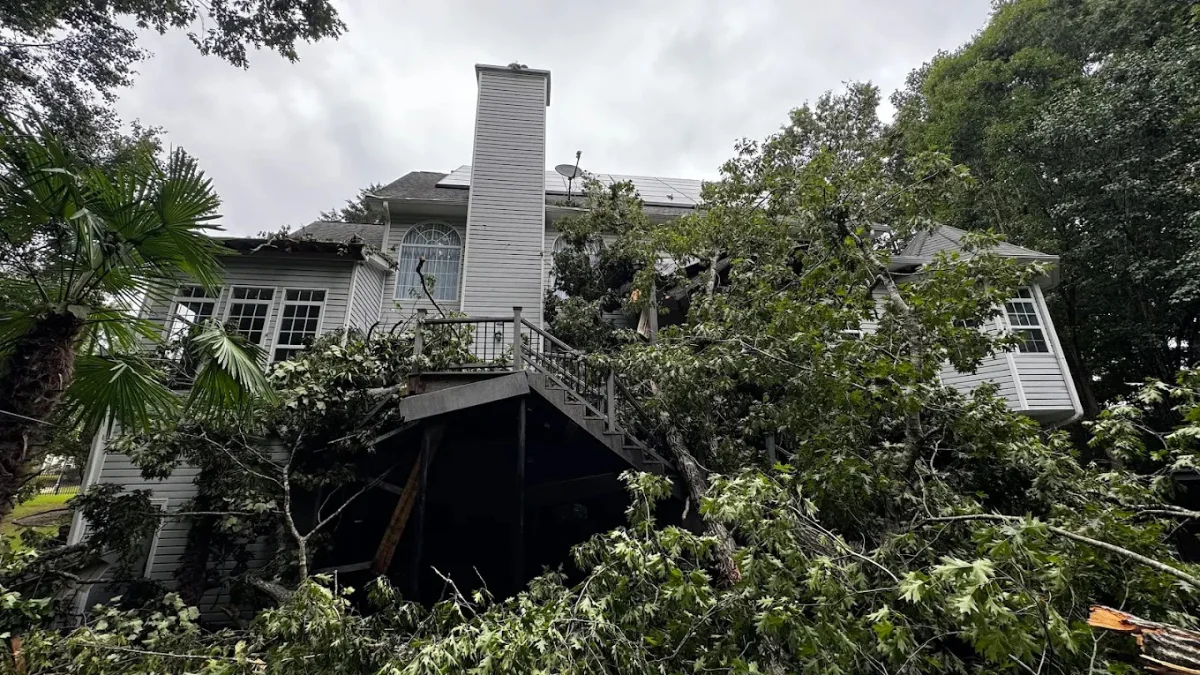
Georgia thunderstorms don’t care about your schedule, and tree damage after a storm can range from a few broken twigs to a situation that threatens your entire home. One hour your yard looks perfectly fine. The next, you’re standing outside staring at a split trunk, a hanging branch the size of a small car, and a pine tree that’s definitely leaning in a direction it wasn’t before. Some of that damage is obvious. But the hidden damage is often what gets people hurt, and that’s exactly what this guide is designed to help you find.
Before You Take a Single Step Outside
The most important thing you can do right after a storm is pause before you walk out the door. Seriously. Take thirty seconds and look through a window first.
Downed power lines are the number one immediate hazard after any severe storm. If you see a line on the ground, on a tree, or draped across a fence, stay away from it and keep your kids and pets inside. Assume it’s live until Georgia Power or your local utility company tells you otherwise. A line lying still on the ground can still carry a lethal charge.
Once you’re outside, don’t stand under any tree that’s visibly damaged, cracked, or leaning at an unusual angle. Trees don’t send a warning before they fall. If the storm hit at night, wait until full daylight to do your walkthrough. Assessing damage in the dark is how people get seriously hurt, and no amount of urgency is worth that risk.
What You Can See: Obvious Storm Damage to Check For
Visible storm damage usually falls into a few clear categories, and your first job is to identify them before you get close to anything.
Broken or hanging branches are called “widow makers” for a reason. A branch that’s cracked but still attached to the tree is often more dangerous than one that’s already fallen. It’s being held up by a few strips of bark and wood fiber, and all it needs is a gust of wind or someone walking underneath to come down. Look up. Check every major limb on trees near your house, your driveway, and any areas where people walk regularly.
Split trunks are another serious sign. A lightning strike or straight-line wind can crack a trunk right down the center, and the tree might still be standing. It might even look mostly fine from a distance. But a split trunk means the structural integrity of that tree is gone, and it needs to be looked at by a professional before you make any decisions about what to do next. Also check for bark that’s been stripped off in long vertical strips, which is a classic sign of a lightning strike. And if you see branches resting on a power line anywhere on your property, don’t touch them. Call your utility company and let them handle it.
Less Obvious Damage: What You Might Miss on a Quick Walkthrough
Not all storm damage announces itself. Some of the most dangerous problems are the ones you have to look for.
Run your hand along the bark of your larger trees and feel for gaps or separation. Cracks in the trunk or major limbs aren’t always visible from a few feet away, but you can often feel them. Look at the soil around the base of each tree, too. Soil that’s heaved up or cracked in a ring around the base is telling you the roots have moved, even if the tree looks upright. That’s a warning sign you don’t ignore.
A new lean is another one to watch for. Even a few degrees of tilt that wasn’t there before the storm is a red flag. And here’s something most homeowners don’t think to do: tap on the trunk with your knuckles. A healthy trunk sounds solid. A hollow sound can indicate internal decay that was already there and just got worse under storm stress. Finally, watch your trees in the days after a storm. Wilting or browning leaves can indicate root damage or vascular disruption from a lightning strike, and that kind of delayed symptom is easy to miss if you’re not looking for it.
(If you’re not sure what “normal” looks like for your trees, that’s actually a very common problem. Most homeowners don’t have a baseline, which is one reason a professional assessment is so useful even when there’s no obvious damage.)
Why Northwest Atlanta Is a High-Risk Area for Storm Tree Damage
Northwest Atlanta isn’t just another suburban area when it comes to storm risk. Cobb, Paulding, Douglas, Fayette, and Cherokee counties sit in a corridor that sees some of the most intense thunderstorm activity in the entire Southeast.
Georgia’s clay soils play a huge role in storm damage that a lot of people don’t think about. When those soils get saturated during heavy rain, they lose a significant amount of their ability to anchor tree roots. The National Weather Service has documented straight-line winds of 60 to 80 miles per hour or more from Georgia thunderstorms, and when those winds hit ground-saturated soil, trees that looked perfectly healthy can uproot with almost no warning. This is especially true for shallow-rooted species like sweet gums and tulip poplars, which are everywhere in this part of the state.
The tree canopy in Northwest Atlanta is also denser than most parts of the country. Mature white oaks and water oaks in neighborhoods like Lost Mountain, Kennesaw, and Powder Springs can have canopies spanning 60 to 80 feet. Loblolly pines, which are common throughout Paulding and Douglas counties, can reach heights of 100 feet or more. That’s a lot of mass moving in a storm, and when one of those trees fails, it doesn’t just fall on your yard. It falls on your roof, your car, your fence, and sometimes your neighbor’s property.
For context on how lightning affects trees specifically, the University of Florida’s IFAS Extension has published research showing that lightning-struck trees have a high likelihood of delayed mortality, sometimes dying weeks or months after the strike with no immediate visible signs. That’s why professional assessment after a suspected lightning strike matters so much. QDS TreeWorx’s 24/7 emergency tree services in Northwest Atlanta are specifically equipped to handle post-storm assessments for exactly this kind of scenario.
When You Need to Call a Professional Right Away
Some situations don’t require a judgment call. They require a phone call.
If any tree or large branch is touching your roof, resting on your fence, sitting on your car, or anywhere near a structure, that’s an emergency situation. You need professional help before anyone goes near it. The same goes for any tree that’s leaning toward a structure or toward a power line. A tree in that position is under tension, and that tension can release suddenly when someone tries to move anything nearby.
A split trunk or a visibly uprooted root ball also puts a tree in the immediate-removal category. You might be tempted to wait and see if the tree stabilizes. It won’t. Once a root ball has lifted on one side, the anchoring system is compromised and the tree will continue to shift. QDS TreeWorx’s storm damage tree removal and cleanup services cover exactly these emergency scenarios, and getting a professional out quickly is always the right call.
And honestly, if you’re just not sure? That’s a completely valid reason to call. You’re not being paranoid. Trees near homes are serious hazards, and there’s no shame in wanting a second set of trained eyes on the situation.
What Not to Do and How to Document Damage for Insurance
Two things that homeowners consistently do wrong after a storm: they try to handle big branches themselves, and they wait too long to deal with hanging limbs.
Don’t attempt to remove large branches or fallen trees on your own. This is genuinely one of the most dangerous DIY jobs a homeowner can try. A branch that’s been partially cracked by a storm is under enormous tension, and cutting it in the wrong place can send it snapping in an unexpected direction instantly. Chainsaws and tension wood are a dangerous combination even for experienced professionals. Leave it alone until someone qualified can assess it.
On the documentation side, photograph every piece of damage before any work starts. Walk your entire property and take pictures of broken branches, split trunks, uprooted root balls, and any damage to structures. Include photos that show the size of the tree relative to your house or the distance from the power line. Write down the date and time. This documentation is critical if you’re going to file an insurance claim, and it’s easy to forget once you’re in cleanup mode. You can request a free tree damage assessment from QDS TreeWorx, and the team can also help you with documentation for insurance purposes once they’re on site.
Frequently Asked Questions
How do I know if a tree is going to fall after a storm?
That’s one of the most common questions I hear from homeowners here in Northwest Atlanta, and the honest answer is that no one can predict it with complete certainty. But there are warning signs that tell you a tree is at serious risk. A new lean, soil heaving around the base, a split trunk, or hanging branches are all signs that something has fundamentally changed in that tree’s structure. Here at QDS TreeWorx, we’ve been doing this in Cobb, Paulding, and Douglas counties since 1993, and we’ve seen trees that looked perfectly fine drop a major limb within hours of a storm. When in doubt, keep people away from the area and get a professional out to look at it.
Is it safe to stay in my house if a tree is leaning against it?
That depends on the size of the tree, how it’s resting, and what part of the structure it’s touching. A small branch resting lightly on a gutter is very different from a 70-foot water oak with its base against your exterior wall. In Cobb County and across the Northwest Atlanta area, QDS TreeWorx responds to these situations around the clock because they genuinely can be emergencies. My recommendation is always to have a professional assess the situation before you make a comfort decision. If the tree is large and it’s resting on a load-bearing part of your home, I’d want you out of that area of the house until we’ve had a look.
Can a tree survive a lightning strike?
Yes, some trees do survive lightning strikes, and some don’t show any external signs of failure for weeks or months. Georgia’s loblolly pines and oaks are both common lightning targets in the Cherokee and Paulding County areas. What happens internally depends on the intensity of the strike, the moisture content of the tree, and the species. A certified arborist from QDS TreeWorx can assess a lightning-struck tree in the Northwest Atlanta service area and give you an honest opinion on whether it’s recoverable or whether removal is the safer choice. We’ve seen trees come back after a strike, and we’ve seen trees that looked fine turn into hazards two months later.
What should I do about my neighbor’s tree that fell into my yard?
This is a surprisingly common situation after Georgia storms, especially in the denser neighborhoods around Marietta and Woodstock. Generally speaking, if a tree from a neighboring property falls into your yard, the damage to your property may be covered by your homeowner’s insurance. QDS TreeWorx serves homeowners throughout the Northwest Atlanta area and can help with the removal side of things. The documentation piece matters here too. Photograph everything before anyone moves anything, and document where the tree originated. We can assist with that when we’re on site, and we can help make the cleanup process as straightforward as possible for everyone involved.
How long do I have to address storm-damaged trees before they become a hazard?
There’s no universal timeline, and that’s actually the problem. A hanging branch can fall the same day. A tree with a compromised root system might stand for two weeks before it topples. The answer really depends on the type of damage, the size of the tree, and what’s in its fall zone. Here in Northwest Atlanta, where large mature trees are so common in communities like Douglasville, Powder Springs, and Fayetteville, that fall zone often includes a home, a car, or a power line. QDS TreeWorx has been handling these assessments for over 30 years, and my honest advice is always the same: don’t treat this like something you can put on the to-do list for next month. Get eyes on it quickly.
Storm damage is unpredictable, but your response to it doesn’t have to be. Knowing what to look for, when to stay back, and when to call for help puts you in a much safer position than most homeowners are in after a major storm rolls through. The more familiar you get with your trees before a storm hits, the easier it is to spot the changes that matter when one does.
Storm Damage on Your Property? QDS TreeWorx Is Available 24/7.
QDS TreeWorx has served Northwest Atlanta with trusted tree care since 1993. Our team responds rapidly to storm damage across Cobb, Paulding, Douglas, Fayette, Cherokee, and Polk Counties. Licensed, insured, and OSHA/ISA compliant. Visit qdstreeworx.com to request your free estimate or emergency response.

